
Why Women's Work Is Often Remembered Without Their Names
September 15, 2026 · 5 min read
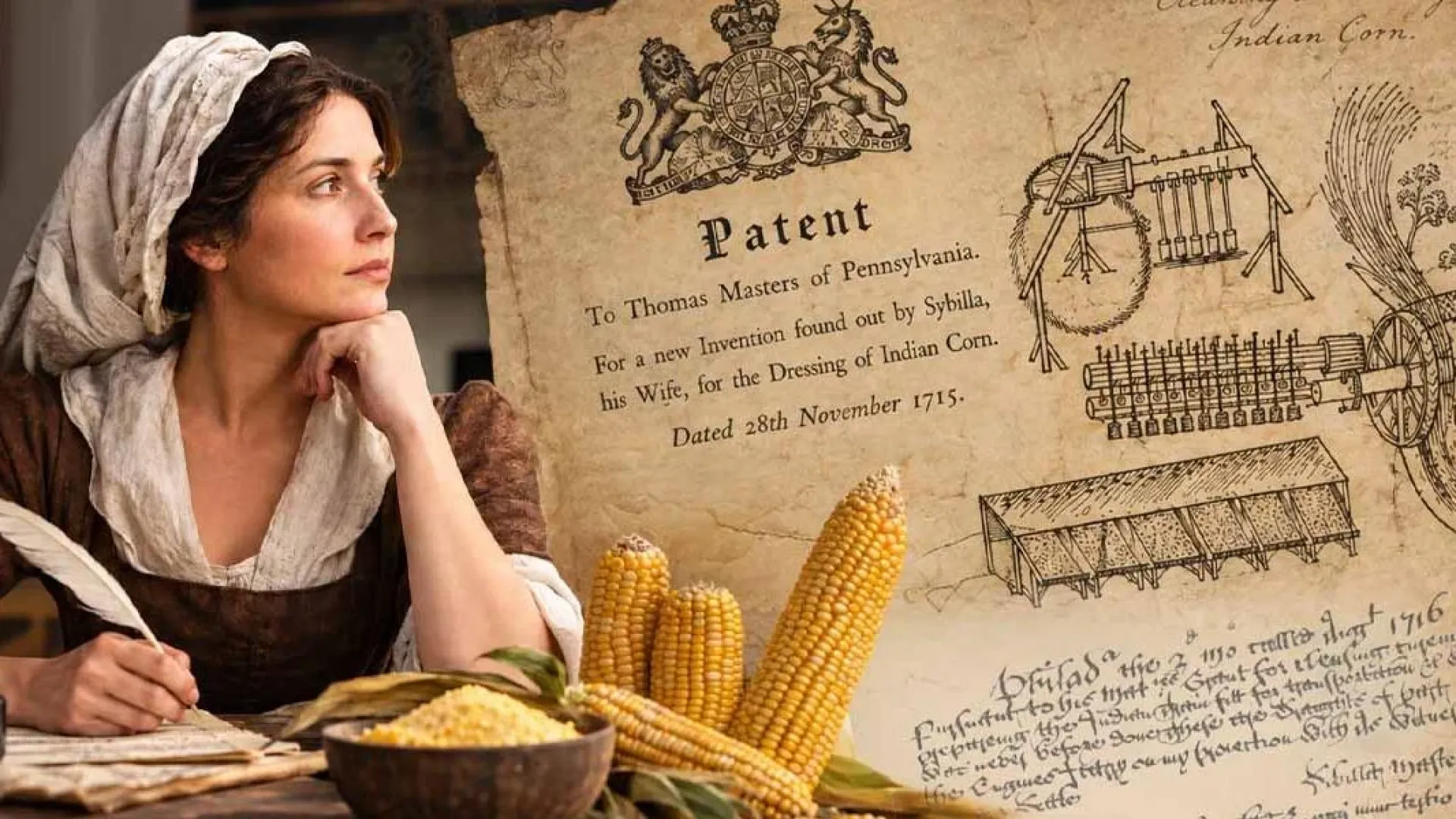
Here is a name most of us were never taught. lived in Philadelphia in the early 1700s, raising four children and working out a better way to process corn. Instead of grinding the kernels, her machine dropped heavy pestles onto them, producing a meal she called Tuscarora Rice. The American colonies had no patent system, so in 1712 she sailed to England to petition the Crown herself and stayed there four years waiting on an answer. The invention was never the problem.
Under British law, a married woman could not hold a patent in her own name. When the patent was granted in November 1715, it went to her husband, Thomas Masters, for what the document called a new invention found out by Sybilla, his wife. The record was perfectly clear about who had done the thinking. The legal right still belonged to him, and his is the name that traveled with the work for the next three hundred years. She did the work, and history made room for someone else.
The detail that makes her case unusual is that Thomas said so. He stated in the submission that the invention was his wife's, and the King acknowledged it publicly, and that single sentence in a 1715 document is the only reason her name reached us at all. A second patent followed in 1716 for her method of weaving palmetto and straw into hats and bonnets, issued the same way, under his name. She returned to Pennsylvania that year and died in 1720. Everything we know about her authorship rests on a husband who happened to put it in writing, which is a thin thread to hang a life's work on.
Her story is not unusual. For generations, women's ideas, discoveries, businesses, and leadership were filed under a husband's name, counted as assistance, or left out of the public record entirely. The National Women's History Museum reports that women obtained more than 5,500 American patents between 1865 and 1900, a stretch often called the golden age of invention. Most of us would struggle to name five of those women. The work survived. The names did not.
What makes the pattern difficult to see is that it rarely required anyone to lie. The law did most of the work. Coverture, the doctrine that merged a married woman's legal existence into her husband's, meant she could not own property, enter contracts, keep her wages, or hold a patent. A clerk recording a husband's name on a document was not committing fraud. He was following the statute, and the statute had already decided whose name the work would carry before anyone in the room had an opinion about it.
When the legal barrier fell, the habit stayed. Margaret Knight invented a machine to produce flat-bottomed paper bags in the late 1860s, and a man named Charles Annan copied her design and filed for the patent himself, arguing in the dispute that a woman could not possibly have understood the mechanics involved. She produced her drawings, her notes, and her witnesses, and she won in 1871. That she had to prove she had thought of her own machine, in a proceeding, against a man who had simply taken it, tells you what the law changing did and did not accomplish.
The twentieth century ran the same play with better manners. Lise Meitner worked out the physics of nuclear fission with Otto Hahn and explained the results he could not interpret, and the 1944 Nobel Prize in Chemistry went to Hahn alone. Rosalind Franklin produced the X-ray image that made the structure of DNA legible, and the 1962 Nobel went to Watson, Crick, and Wilkins after her death. Jocelyn Bell Burnell identified the first pulsar as a graduate student in 1967, and the 1974 Nobel went to her supervisor. In none of these cases did anyone forge a document. The contribution was simply reclassified as assistance, and assistance does not get a name attached.
That reclassification is the mechanism still operating, and it is why this is not only a history piece. A woman's idea in a meeting becomes the team's idea. Her project becomes the department's project. The work she did for eighteen months becomes something that happened during a period when she was involved. Nobody decides this. It accumulates through a hundred small choices about phrasing, and the result is a record in which the work is present and the person is not.
This is what recognition is actually for, and it has very little to do with an award or a photograph. Recognition ties a woman's name to the thing she built so the two stay together in the record. It puts something in writing that can still be found by whoever goes looking later. The reason we know about Sybilla Masters is a sentence her husband wrote in a patent application in 1715. Everything else about her authorship would have vanished, and for most of the women working alongside her, it did.
The practical version of this is smaller than it sounds and it belongs to whoever is in the room. Say the name when you describe the work. Write it down where the writing survives, in the minutes, in the announcement, in the case study, in the file that someone opens in five years. Correct the record when it drifts, which it will, usually without malice and always in the same direction. When someone hands you credit that belongs to a woman who is not there, return it out loud.
She was here. She did this. Her work mattered. Three hundred years on, that is still the whole of what has to be written down, and it is still the part that gets left out.